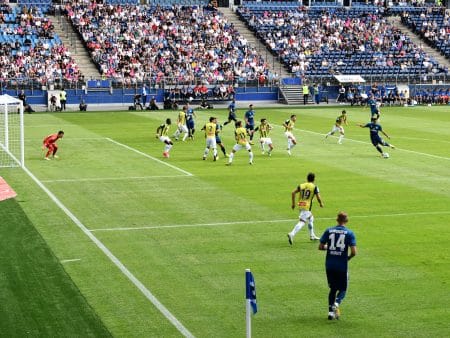
How the NPFL Built Super Eagles Legends: From the Domestic League to the World Stage
The relationship between the NPFL and the Super Eagles is one of the most important stories in Nigerian football — and one that does not get nearly enough attention. The Nigeria Premier Football League has, since its establishment in 1972, served as the primary incubator of the players who went on to represent Nigeria at AFCON, the FIFA World Cup and the Olympic Games. From Rashidi Yekini’s early career in Nigerian football to the modern era of talent development, the NPFL Super Eagles connection runs through every chapter of Nigeria’s football story. This piece examines how the domestic league built Nigeria’s football identity and the legends it helped produce.
The NPFL as Nigeria’s Football Foundation
Every great footballing nation needs a strong domestic league. For Nigeria, the NPFL has been that foundation — the competition where players develop their technical skills, physical conditioning and competitive mentality before moving on to bigger stages. The league’s double round-robin format, with roughly 38 matches per season, gives players consistent high-level competition across a demanding calendar.
Furthermore, the NPFL’s geographic spread — with clubs from Lagos to Kano, from Aba to Maiduguri — means that talent from every corner of Nigeria has a competitive pathway at the top level. A technically gifted teenager from Owerri can join Heartland FC; a powerful striker from Kano can develop at Kano Pillars. The league’s reach across Nigeria’s vast and diverse geography has always been one of its greatest strengths as a talent incubator.
The clubs that have invested most seriously in youth development — Enyimba in particular, but also Rangers International, Kano Pillars and several others — have produced a disproportionate share of Super Eagles players across different generations. This is not a coincidence. It reflects the quality of coaching, the intensity of competition and the culture of ambition that the strongest NPFL clubs foster.
Rashidi Yekini: The NPFL’s Most Famous Export
No discussion of NPFL Super Eagles legends is complete without Rashidi Yekini — Nigeria’s all-time leading international goal scorer and one of the most celebrated strikers in African football history. Yekini’s development as a footballer in the Nigerian league system provided the foundation for a career that would take him to Portugal, Spain and, ultimately, to the 1994 FIFA World Cup in the United States, where he scored Nigeria’s first-ever World Cup goal against Bulgaria.
Yekini’s iconic celebration after that goal — grabbing the net and shaking it, half-laughing, half-crying with joy — became one of the defining images of African football in the 1990s. His league career in Nigeria shaped the physical toughness, goal-scoring instinct and competitive mentality that made him so effective at the highest level. As historical profiles from Punch Nigeria and Premium Times have documented, Yekini’s story is a direct line from the domestic Nigerian league to the highest stages of world football.
His record of goals for the Super Eagles — built across more than a decade of international service — has not been surpassed, and his legacy as the most prolific Nigerian international striker of all time remains secure. For many Nigerians, Yekini’s name is synonymous with the NPFL’s ability to produce world-class talent.
The 1994 Golden Generation and the NPFL Connection
The 1994 Super Eagles squad — widely regarded as the greatest Nigerian team ever assembled — drew heavily from the talent pool that the domestic league had developed. While many of the 1994 squad were already playing in Europe by the time of the World Cup, their formative years in Nigerian football built the technical and tactical foundation for their later careers.
Players like Sunday Oliseh, Daniel Amokachi and other squad members had moved through the Nigerian club system before earning moves abroad. The NPFL was, for these players, the proving ground where they demonstrated the quality that attracted European clubs. Consequently, the 1994 Super Eagles represent not just the story of individual talent, but of a domestic league that was capable of producing world-class footballers in significant numbers at the same time.
Jay-Jay Okocha — widely regarded as the greatest Nigerian footballer of all time — also benefited from the domestic football culture that the NPFL system supported before his move to Germany with Borussia Frankfurt and then the great run through Paris Saint-Germain and Bolton Wanderers. Okocha’s extraordinary technical skill was shaped in part by a Nigerian football tradition that valued flair, creativity and one-on-one brilliance.
The NPFL-to-Europe Pipeline
The most significant long-term contribution of the NPFL Super Eagles connection is the pipeline it has created from Nigerian domestic football to European clubs. Scouts from Premier League, Serie A, Bundesliga and other European leagues have regularly attended NPFL matches looking for the next generation of Nigerian talent to export.
This pipeline has been active across multiple decades and shows no sign of slowing. The modern era has produced players like Victor Osimhen, who developed in the Nigerian academy system before European clubs came calling. While Osimhen’s meteoric rise took him through several stages before his breakthrough at Napoli and Galatasaray, the foundational work was done in the Nigerian football environment. As Nigerian players in the Premier League 2025/26 shows, the Super Eagles continue to supply significant Premier League talent in the current era.
The pipeline works in multiple directions. Young Nigerian players who develop at NPFL clubs and move to Europe frequently return for international duty, bringing back the technical refinements and tactical sophistication of European football to enrich the Super Eagles squad. That exchange between the domestic league and the international game has been one of Nigeria’s most important footballing assets.
The CAF Champions League as a Bridge
The CAF Champions League has historically served as an important intermediate stage between the NPFL and European football. When NPFL clubs compete in the CAF Champions League, they face the best club sides from across Africa — Egypt, Morocco, Tunisia, South Africa and beyond — in a competitive environment that sharpens players in ways the domestic league alone cannot.
Enyimba’s two back-to-back CAF Champions League titles in 2003 and 2004 produced Super Eagles players who gained invaluable continental experience. The exposure to different tactical systems, playing surfaces and opposition quality that comes with a deep CAF Champions League run broadens a player’s football education in ways that directly benefit the Super Eagles when those players earn international call-ups.
Furthermore, a strong NPFL club’s CAF campaign raises the profile of the entire Nigerian league internationally, attracting more scouting attention and making it easier for other NPFL players to secure European moves. The success of Enyimba in African club competition had ripple effects that benefited Nigerian football broadly, not just the club itself.
Why a Strong NPFL Matters for the Super Eagles’ Future
The link between NPFL quality and Super Eagles success is not simply nostalgic — it has direct implications for the national team’s future. As BBC Sport’s African football analysts have observed, national teams that lose connection with their domestic league development pathway typically experience talent pipeline fragility over time.
Nigeria’s football authorities understand this connection and have repeatedly emphasised the importance of developing the NPFL’s quality, infrastructure and commercial appeal. Stronger NPFL clubs attract better coaches, more competitive salaries, and a higher calibre of playing staff — which in turn produces more Super Eagles-ready talent. The virtuous cycle that flows from a strong domestic league to a competitive national team is one of the clearest lessons in African football development history.
For Nigerian fans who follow both the NPFL and the Super Eagles, watching a young domestic striker have a breakout NPFL season and wondering whether he has what it takes for international football is one of the most exciting recurring narratives in the Nigerian game. The league has answered that question with world-class players often enough to ensure the answer remains permanently interesting.
For more Nigerian betting guides, visit our best betting sites in Nigeria or explore the top Nigerian bookmakers.
⚡ Back today’s picks: Mozzartbet — ₦50,000 Free Bet + 500 Aviator Free Bets. Read our Mozzartbet review or claim the offer now.
Bet at Mozzartbet →
18+. New customers only. T&Cs apply. Please gamble responsibly.